Sequencing Grade Modified Trypsin


Trypsin Manufactured for Maximum Specificity and Stability
- Sequencing Grade Modified Trypsin uses reductive methylation to block autolysis, delivering consistent, specific cleavage at Arg and Lys residues across experimental replicates.
- TPCK treatment eliminates residual chymotrypsin activity, reducing nonspecific peptide fragments that complicate protein database searches.
- Compatible with mild denaturing conditions: 0.1% SDS, 1M urea, and 10% acetonitrile; retains ~50% activity in 2M guanidine HCl.
- Referenced in thousands of peer-reviewed proteomics publications; available lyophilized or frozen to fit your lab’s workflow.
Catalog Number:
Choose a Format
Size
Catalog Number: V5111
Catalog Number: V5117
Catalog Number: V5113
Sequencing Grade Modified Trypsinは、ブタから精製され、リジン残基およびアルギニン残基のカルボキシル末端側のペプチド結合を特異的に切断します。未修飾トリプシンは自己消化を行うため、その分解産物がタンパク質のアミノ酸配列解析やHPLCペプチド分析、質量分析に影響することがあります。また、トリプシンの自己消化により、疑似トリプシン (pseudotrypsin)を生成し、キモトリプシン様の活性を示すことがあります 。プロメガのSequencing Grade Modified Trypsinは、還元メチル化が施してあるため、自己分解に対して非常に強い抵抗性を示します 。
Sequencing Grade Modified Trypsinでは、さらにTPCK処理を行った後、アフィニティー精製を行っているため、疑似トリプシンが除去された安定な高活性分子を得ることができます。純度検定として、テストペプチドの過剰消化を行い、生成フラグメントのHPLC分析を行っています。本酵素 (V5111) は少量 (20µg)ずつ分注し、安定性を最大限に維持するResuspension Bufferとともに供給されます。タンパク質のアミノ酸配列を分析する場合には、プロテアーゼ:タンパク質 = 1:100~1:20 (w/w)を推奨します。
Modified Trypsinの機能安定性テストでは、37℃、3時間のインキュベート後未修飾トリプシンの少なくとも3倍の活性を示しました。
この製品のカスタムオプションについてさらに知りたい方はこちら
推奨する反応バッファー: 50mM NH4HCO3 (pH 7.8).
- 高純度:TPCK処理後、アフィニティー精製
- 便利:Resuspension Buffer添付
- 使い易い:5本のチューブに小分け
- Keil-Dlouha, V.V. et al. (1971) FEBS Letters 16, 291–5.
- Rice, R.H. et al. (1977) Biochem. Biophys. Acta 492, 316–21.

Digestion sites for a variety of trypsins and proteases.
What is Reductive Methylation, and How Does It Make Trypsin More Stable?
Reductive methylation modifies the lysine residues on trypsin itself, blocking the enzyme’s self-cleavage sites without affecting its activity toward substrate proteins. The result is a stable, highly active enzyme that resists autolysis throughout extended digestion incubations.
Trypsin cleaves at lysine and arginine residues—including those within its own structure. Reductive methylation adds methyl groups to the ε-amino groups of trypsin’s internal lysine residues, making them resistant to tryptic cleavage. This chemical modification does not alter the enzyme’s active site or its recognition of substrate Lys and Arg residues, so catalytic activity is preserved. The practical result: very few autolytic fragments appear in your digest. Because the enzyme cannot cleave itself, the peptide mixture you analyze reflects only your target protein—not breakdown products of the protease.
What Is TPCK Treatment, and Why Does It Matter for Proteomics?
Tosyl phenylalanyl chloromethyl ketone (TPCK) irreversibly inactivates chymotrypsin by blocking its active site. TPCK-treated trypsin preparations are free of chymotryptic activity, which eliminates nonspecific cleavages at aromatic and large hydrophobic residues that would otherwise generate unexpected peptides.
Commercially available porcine trypsin can contain trace chymotrypsin contamination co-purified from pancreatic extracts. Even small amounts of chymotrypsin can cause cleavage at Tyr, Phe, Trp and Leu residues—sites that should be intact in a tryptic digest. These nonspecific cleavages create peptides that don’t match expected tryptic fragments, increasing missed matches and reducing identification confidence. Sequencing Grade Modified Trypsin is treated with TPCK and then purified by affinity chromatography, providing a preparation with high tryptic specificity and no detectable chymotryptic activity.
Sequencing-Grade Modified Trypsin is only tested for stability and sequence specificity. Promega cannot guarantee that Sequencing-Grade Modified Trypsin will perform if used for mass spectrometry applications. Trypsin Gold and Trypsin Platinum are qualified for mass spectrometry applications. Each lot of the Trypsin Gold, Mass Spectrometry Grade (V5280) is qualified by mass spectrometry to ensure compatibility with your applications/instrumentation. For experiments requiring maximum digestion efficiency with the fewest missed cleavages—such as deep proteome coverage or large-scale quantitative datasets—consider Trypsin Platinum, Mass Spectrometry Grade (VA9000), which offers further optimized specifications for demanding mass spectrometry applications. See the product comparison table.
Which Promega Trypsin Is Right for My Proteomics Workflow?
Promega offers sequencing-grade and mass spectrometry (MS)-grade trypsin options optimized for different applications and levels of digest complexity. Sequencing Grade Modified Trypsin is a proven, versatile choice for most protein sequencing. Trypsin Gold is qualified for use in MS applications. Trypsin Platinum provides maximum specificity for demanding quantitative or low-abundance MS applications.
|
Feature |
Sequencing Grade Modified Trypsin (V5111) |
Trypsin Gold, Mass Spectrometry Grade (V5280) |
Trypsin Platinum, MS Grade (VA9000) |
|---|---|---|---|
|
Autolysis resistance |
Reductive methylation of Lys residues |
Reductive methylation of Lys residues |
Novel modification for maximum resistance to autoproteolysis |
|
Chymotrypsin inhibition |
TPCK treatment; affinity purified |
TPCK treatment; affinity purified |
Recombinant enzyme so no Chymotrypsin is present |
|
Recommended use |
Edman Degradation peptide sequencing |
General shotgun proteomics, in-gel and in-solution digestion prior to mass spectrometry |
Demanding quantitative workflows, deep proteome coverage by mass spectrometry |
|
Formats available |
Lyophilized (5×20μg, 1×100μg) or frozen (5×20μg) |
Lyophilized |
Lyophilized and frozen options |
|
Publications |
Thousands of peer-reviewed citations |
|
Validated for high-sensitivity MS workflows |
|
Denaturant tolerance |
0.1% SDS, 1M urea, 10% ACN; ~50% activity in 2M GuHCl |
|
|
Frequently Asked Questions
What is the cleavage specificity of Sequencing Grade Modified Trypsin?
Sequencing Grade Modified Trypsin cleaves specifically at the carboxyl side of lysine (Lys, K) and arginine (Arg, R) residues. This specificity is fully preserved by the reductive methylation modification. Cleavage does not occur when proline is C-terminal to the cleavage site (Lys-Pro or Arg-Pro bonds). Activity is also reduced when acidic residues flank the susceptible bond. These sequence-dependent missed cleavages are intrinsic to trypsin function and affect all tryptic preparations.
What ratio of trypsin to substrate protein is recommended?
Optimize the enzyme-to-substrate ratio typically between 1:100 to 1:20 final w/w (weight/weight). Higher ratios increase digest efficiency but may also increase autolytic background in preparations not treated with reducing agents.
How should Sequencing Grade Modified Trypsin be stored and resuspended?
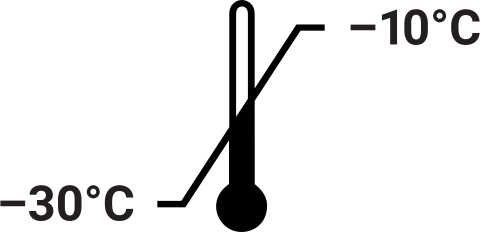
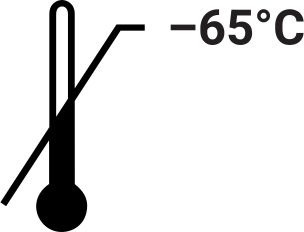
Lyophilized formats (V5111, V5117) should be resuspended in the supplied Trypsin Resuspension Dilution Buffer (V542A) and stored according to the product information sheet. Frozen format (V5113) is supplied at 0.5mg/ml as a liquid and should be stored at −80°C. Avoid repeated freeze-thaw cycles. Refer to the Certificate of Analysis for lot-specific activity data.
What buffer conditions are compatible with trypsin activity?
Trypsin is maximally active in the pH range of 7 to 9 but is reversibly inactivated at pH 4. The enzyme tolerates mild denaturants used to improve protein solubility like 0.1% SDS, 1M urea, and 10% acetonitrile final concentrations.The recommended digestion buffers include 50mM NH4HCO3 (pH 7.8) or 50mM Tris-HCl, 1mM CaCl2 (pH 7.6).
Is there a faster digestion option for high-throughput workflows?
Yes. The Rapid-Digestion Trypsin and Trypsin/Lys-C Kits (VA1060, VA1061) are designed for streamlined workflows requiring faster digestion times—typically 1–2 hours rather than overnight—while maintaining specificity. These kits are well-suited for high-throughput proteomics sample preparation.
Specifications
Catalog Number:
選択製品の構成品内容
| Item | Part # | Size |
|---|---|---|
|
Sequencing Grade Modified Trypsin, Porcine (lyophilized) |
V511A | 5 × 20μg |
|
Trypsin Resuspension Dilution Buffer |
V542A | 1 × 1ml |
選択製品の構成品内容
| Item | Part # | Size |
|---|---|---|
Sequencing Grade Modified Trypsin |
V511B | 1 × 100μg |
|
Trypsin Resuspension Dilution Buffer |
V542A | 1 × 1ml |
選択製品の構成品内容
| Item | Part # | Size |
|---|---|---|
|
Sequencing Grade Modified Trypsin, Porcine, Frozen (liquid 0.5mg/ml) |
V511C | 5 × 20μg |
|
Trypsin Resuspension Dilution Buffer |
V542A | 1 × 1ml |
Related Products
類似製品
Trypsin Platinum, Mass Spectrometry Grade
最高レベルの消化特異性、自己消化に対する卓越した耐性
VA9000
Endoglycosidase H
タンパク質輸送のモニタリングやマススペクトロメトリーによる糖鎖の位置や構造決定といったアプリケーションにおいてタンパク質の糖鎖修飾をキャラクタライズします。
V4871, V4875
PNGase F
N結合型糖タンパク質から高マンノース、ハイブリッド型オリゴ糖、複合型オリゴ糖の最も内側のGlucNAc残基とアスパラギン残基間のN結合型糖切断を触媒します
V4831
Trypsin/Lys-C Mix, Mass Spec Grade
Trypsin GoldとrLys-Cの混合物で高いペプチド回収率、優れたタンパク質定量精度、安定した再現性
V5071, V5072, V5073
関連製品
Magnetic Proteomics Sample Prep (MPSP) Kit
SP3法によるプロテオームサンプル調製を効率化する磁気ビーズ
CS3325A04
Arg-C Ultra, Mass Spec Grade
Arg-Pro 配列を含むアルギニン残基の C 末端を切断するエンドペプチダーゼ
VA1831, VA1832
Lys-C, Mass Spec Grade
Cleavage site: C-terminal of Lys. Optimal pH: 7–9.
VA1170
Chymotrypsin, Sequencing Grade
Tyr, Phe, TrpのC末端側を優先的に加水分解するセリンプロテアーゼ
V1061, V1062
