Kinase Target Engagement
The NanoBRET® Target Engagement (TE) Intracellular Kinase Assays provide a way to quantitatively measure specific kinase-inhibitor interactions in live cells using Bioluminescence Resonance Energy Transfer (BRET). The assay measures the apparent cellular affinity of test compounds bound by competitive displacement of a cell-permeable fluorescent NanoBRET® tracer, reversibly bound to a kinase-NanoLuc® luciferase fusion in cells.
NanoBRET® Kinase Target Engagement Assays
- Measure Kinase Target Engagement in Live Cells: Quantify compound affinity & fractional occupancy for multiple types of kinase inhibitors (I-IV).
- Assays for over 340 Kinases: Ready-to-use assays span the kinome, readily enabling selectivity analysis.
- Use Full-Length Kinase: Assays use full-length wild-type kinases. Select mutant kinase or domain-specific kinase assays are available.
- Multi-Well Plate Format: Simple assay method is scalable from 96-well to 384-well or beyond.
- Assess Residence Time: Determine duration of test compound binding to target kinase in live cells.

What You Need to Perform a NanoBRET® TE Assay
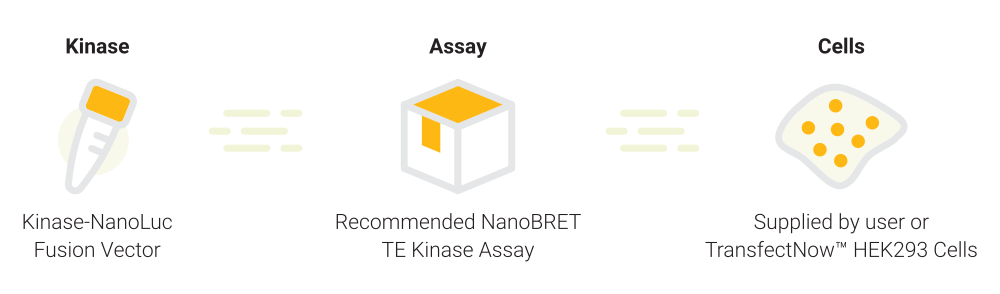
The tracers and substrate/inhibitor combinations are also available as standalone products.
Filter By
Shop All Kinase Target Engagement Products
Showing 16 of 16 Products
How NanoBRET® Kinase Target Engagement Assays Work
A Kinase-NanoLuc® fusion vector is introduced by transfection into mammalian cells and allowed to express. As NanoLuc® luciferase is extremely bright, only low expression of the kinase-NanoLuc® fusion protein is needed.
In the NanoBRET® TE Kinase Assay, a cell-permeable fluorescent NanoBRET® tracer, a NanoLuc® substrate, and the Extracellular NanoLuc® Inhibitor are supplied. Addition of these to cells expressing the kinase-NanoLuc® fusion allows a strong BRET signal to be achieved between the kinase-NanoLuc® protein and NanoBRET® tracer. The extracellular NanoLuc® inhibitor ensures that the BRET signal achieved is from live, uncompromised cells.
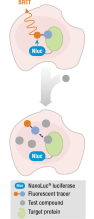
The presence of unlabeled test compound that binds to target kinase results in a loss of BRET signal. As BRET has tight distance constraints, the data obtained is specific for the kinase fused to NanoLuc® luciferase. In addition, the data results in a quantitative intracellular affinity provided the appropriate tracer concentration is used.
Example Kinase Target Engagement Data
Measure Affinity, Selectivity, Potency and Residence Time
Obtain Quantitative Measurement of Compound Intracellular Affinity
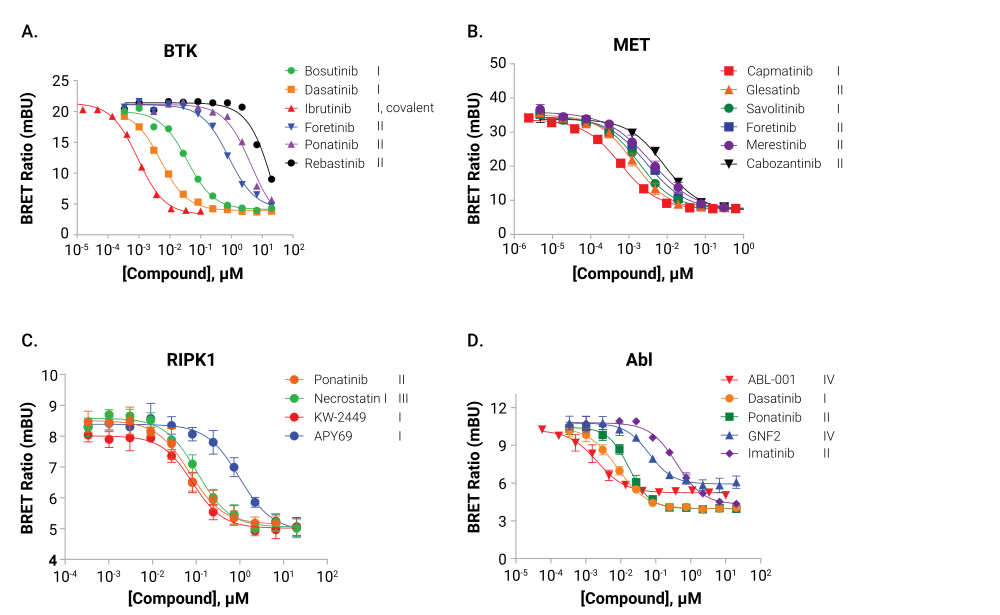
Determine Compound Cellular Selectivity and Fractional Occupancy for Related Kinases
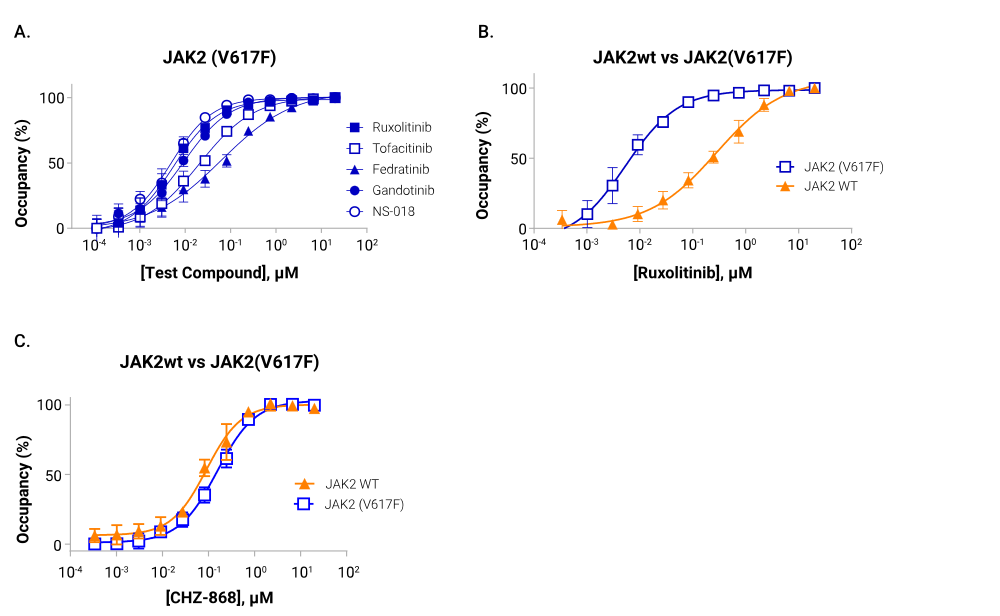
NanoBRET® Target Engagement can be used to compare inhibitor affinity for wild-type (WT) and mutant kinases. NanoBRET® TE Intracellular Kinase Assay K-10 was used for JAK and JAK(V617F), which is a clinically acquired mutation found in myeloproliferative cancers. Panel A: Engagement of Type I ATP competitive inhibitors against JAK2(V617F). Panel B: Target engagement potency was stronger for Type I inhibitor ruxolitinib with JAK2(V617F) versus JAK2 wild-type. Panel C: This differed from the finding with the Type II inhibitor CHZ-868, which had similar affinity for both JAK2(V617F) mutant and JAK2 wild-type kinases.
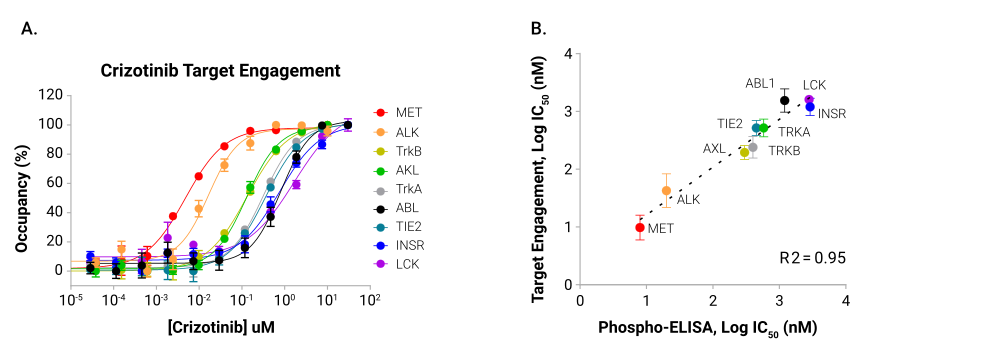
Achieve Improved Correlation between Compound Affinity and Downstream Functional Potency
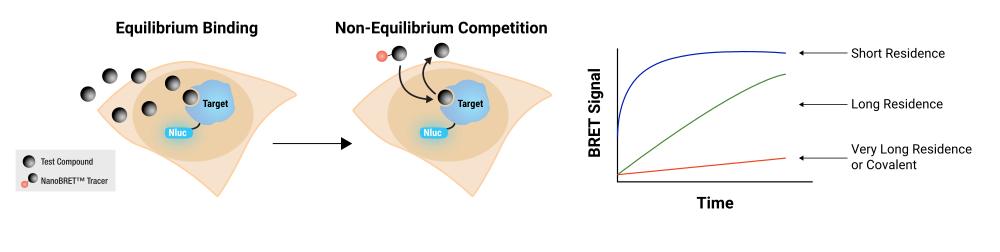
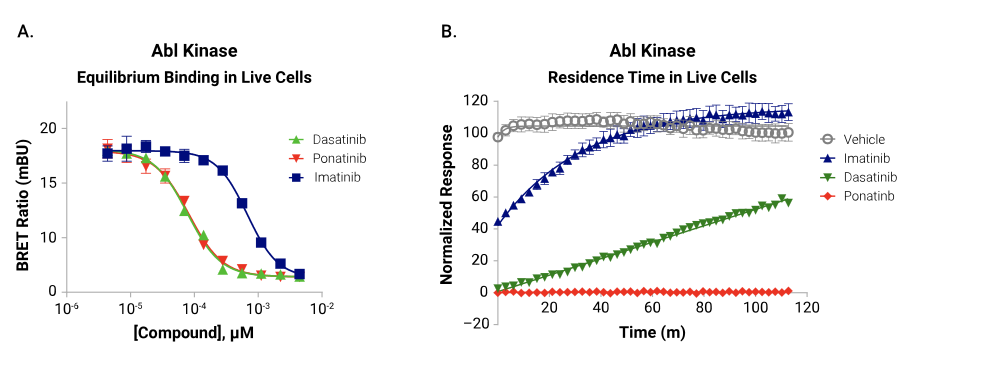
Assess Compound Residence Time in Live Cells
Q & A
NanoBRET™ TE Intracellular Kinase Assay(#TM598および#TM603)の技術マニュアルではHEK293細胞を使用していますが、HeLaやU2OSなどの細胞タイプでも使用されています。HEK293と異なる細胞タイプを使用する場合は、NanoLuc® 融合ベクター導入する際のトランスフェクション条件について最適化することを推奨します。
新しい付着(ADH)アッセイフォーマットは、オリジナルの非結合表面(NBS)アッセイフォーマットと比較してより効率的です。ADH フォーマットでは、組織培養処理プレートで接着細胞を使用します。
NBS フォーマットでは、アッセイプレートに移す前日に細胞をプレートまたはディッシュにトランスフェクションする必要があります。アッセイ当日に細胞を採取し、アッセイを実行する前に非結合表面アッセイプレートに播種します。非結合表面プレートは、従来のポリスチレンアッセイプレートでの使用に適さない特定のトレーサーに最適です。
ADH フォーマットでは組織培養処理プレートを使用し、アッセイプレートでキナーゼ - NanoLuc® 融合ベクターをトランスフェクションすることができます。前日にトランスフェクションした細胞をアッセイプレートに播種するため、ADHフォーマットでは回収と播種のステップは不要です。
使用可能なすべてのキナーゼおよびキナーゼ複合体は、アプリケーションノートおよびデータへのリンクとともにここにリストされています。すでにNBS フォーマットでテストされている場合は、別のアプリケーションノートのリンクが表に付加されています。アプリケーションノートは、個々のキナーゼ- NanoLuc® 融合ベクターの製品ページでもご覧いただけます。
最大のアッセイウィンドウを提供するためにキナーゼごとに推奨されるアッセイ/トレーサーが1つあります。ただし、いくつかのキナーゼには、他のアッセイ法が記載された追加のアプリケーションノートがあります。推奨アッセイ以外の追加データについては、キナーゼ - NanoLuc® 融合ベクターの製品ページで提供されているものもあります。
ニーズに応じて、最大のウィンドウを持つアッセイは有利な場合があるため推奨されるアッセイとして選択されます。他の場合には、複数のキナーゼに対して同じアッセイ/トレーサーを使用することが望ましい場合があります。この場合、推奨されるアッセイは、研究する各キナーゼで同じではない場合があります。アッセイウィンドウとアッセイ機能のガイドラインについては、#TM598または#TM603を参照してください。
当社のカスタムアッセイサービスでは 追加のキナーゼNanoLuc®融合ベクターとNanoBRET™ TE Kinase Assay を開発し、提供してきました。ご希望のキナーゼアッセイが開発されていない場合にはカスタムチームが開発、あるいはご自身でのアッセイ開発をサポートいたします。こちらからお問い合わせください。
公表文献
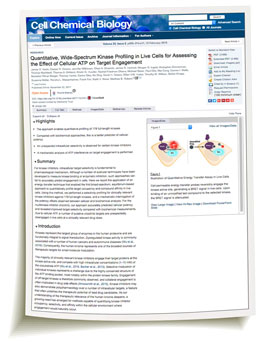
標的エンゲージメントに対する細胞内ATPの効果を評価するための生細胞における定量的キナーゼプロファイリング
2018年 Vasta et al の Cell Chemical Biology の記事。 生細胞内のキナーゼターゲットエンゲージメントを測定する生物発光共鳴エネルギー移動(BRET)ベースの方法について記述しています。
ハイスループットなBRET細胞内 ターゲットエンゲージメントアッセイは、ブルトン型チロシンキナーゼの生化学と細胞活性をリンクする
2019年 Ong et al のSLAS Discovery の記事。NanoBRET™TEメソッドを用いた BTKのターゲット占有率の分析。
エネルギー移動を使用した細胞内ターゲットエンゲージメントの定量的なリアルタイム測定
2018年 Robers et al の書籍 Methods in Molecular Biology の章。多様な細胞内因子の存在下で親和性と滞留時間を定量化する方法について解説。How Can We Help You?
In addition to the pre-built kinase assays featured on this page, we also offer kits and reagent to build your own NanoBRET® Target Engagement assays, and custom assay development capabilities.