NanoBRET® TE PRMT5 Assay
Detect Multiple Modes of PRMT5 Engagement in Live Cells
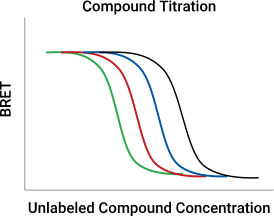
- Measure intracellular compound affinity for PRMT5
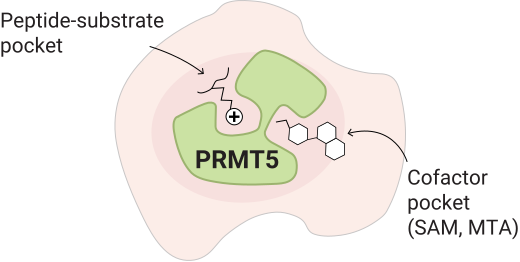
- Evaluate target engagement at both the peptide-substrate binding pocket and the cofactor binding pocket
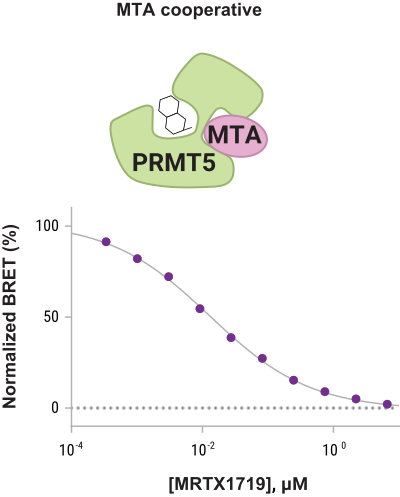
- Characterize the binding of MTA-cooperative inhibitors to PRMT5-MTA complex in live cells
- Optimized assay using a simple, addition-only workflow

Catalog Number:
Choose a product
Size
Catalog Number: CS3489A02
Catalog Number: CS3489A03
Catalog Number: CS3489A22
Measure Target Engagement to PRMT5 in Live Cells
Protein arginine methyltransferase 5 (PRMT5) catalyzes arginine methylation for both histone and non-histone substrates and uses S-adenosylmethionine (SAM) as the cofactor and methyl group donor. PRMT5 regulates a wide spectrum of cellular processes, such as cell signaling and differentiation, RNA splicing and DNA damage response, and has been shown to be a promising synthetic lethality target for MTAP (methylthioadenosine phosphorylase)-deleted cancer cells.
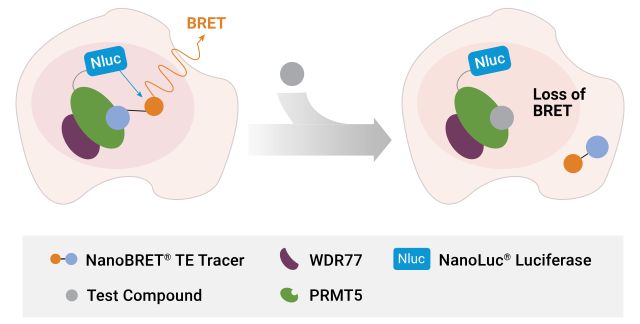
The NanoBRET® TE PRMT5 Assay can be used to quantify affinity of PRMT5 inhibitors with different modes of action in live cells. The assay is based on the NanoBRET® technology, an energy transfer technique designed to measure molecular proximity in living cells.
Want to accelerate your drug discovery workflow? Our Tailored R&D Solutions team offers services using the NanoBRET® TE Assay for PRMT5.
アッセイ原理
NanoBRET™ TargetEngagement(TE)アッセイは、生物発光共鳴エネルギー移動(BRET)を介して、標的タンパク質に対する試験化合物の親和性を生細胞で測定することを可能にします。このアッセイでは、細胞内で発現した NanoLuc®ルシフェラーゼ-標的タンパク質融合体から、標的タンパク質に結合する細胞透過性蛍光NanoBRET™トレーサーへの発光エネルギーの伝達が起こります。NanoBRET™ TE E3 リガーゼアッセイでは、NanoLuc®-E3リガーゼ融合タンパク質を哺乳動物細胞で発現させます。BRETシグナルを生成するために、固定濃度の細胞透過性蛍光 NanoBRET™ TE トレーサーを細胞に添加すると、NanoLuc®-E3リガーゼ融合タンパク質に結合します。次に E3リガーゼに結合する化合物を添加すると、NanoBRET™シグナルが用量依存的に減少します。このデータは、生細胞での標的 E3 リガーゼタンパク質に対する分解誘導化合物の細胞内親和性を示しています。
Evaluate Target Engagement at Substrate and Cofactor Binding Pockets
NanoBRET™ TE E3 Ligase Assay は、分解誘導化合物の細胞内での利用可能性を測定するためにも使用できます。細胞内の可用性を測定するために、NanoBRET™ TE E3 Ligase Assay の簡単なワークフローを実行します。これには、生細胞モードと透過処理細胞モードの2つのモードが含まれます。生細胞モードで行われる NanoBRET™TE E3 Ligase Assay の場合、細胞膜など化合物の透過や結合性に影響を与える因子が存在する生細胞内で親和性を測定します。一方、透過処理細胞モードでは、NanoBRET™ TE E3 Ligase Assay を、細胞膜がない状態でE3リガーゼに対する化合物の固有の親和性を定量化します。次に、両方のモードからの親和性データを使用して、対照化合物と比較した化合物の細胞内利用可能性を計算します。
A
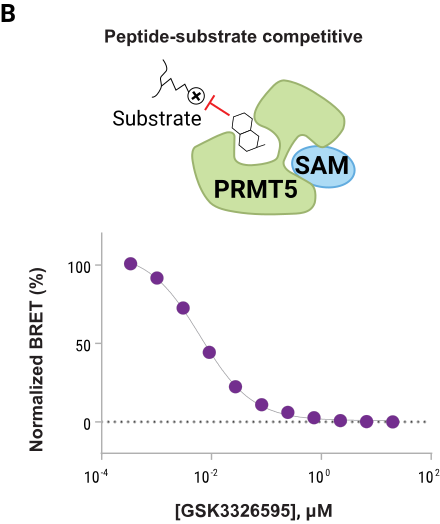
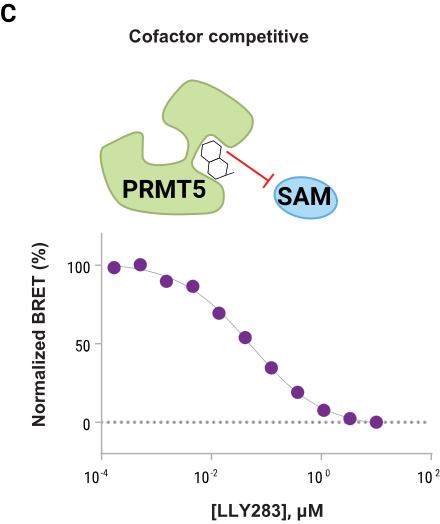
Measure Compound Binding to PRMT5-MTA Complex
In MTAP-deficient cancer cells, there is an accumulation of 5′-Methylthioadenosine (MTA), an intermediate in the methionine salvage pathway. An elevated level of MTA leads to inhibition of PRMT5, sensitizing the cancer cells to further loss of PRMT5 activity and exposing a vulnerability in MTAP-deficient cancers. Developing inhibitors that preferentially engage the PRMT5-MTA complex can exploit this synthetic lethal interaction to selectively target MTAP-deficient cancer cells. The NanoBRET® TE PRMT5 Assay can be used to assess target binding by MTA-cooperative PRMT5 inhibitors in live cells.
See the PRMT5 TE Assay Scientific Poster on how the assay can be used to evaluate the impact of MTA on inhibitor-PRMT5 interactions and characterize MTA-cooperative inhibitors.
What You Need to Perform the NanoBRET® TE Assay
We supply:
- NanoBRET® Tracer PRMT5*
- NanoLuc®-PRMT5 Fusion Vector
- WDR77 Expression Vector
Additional reagents needed for performing the NanoBRET® TE Assay are listed below. A full list of required materials can be found in the Application Note.
*Each vial is sufficient for at least 1,000 assays when used as recommended in the Application Note.
Patents and Disclaimers
Materials may be covered by pending or issued patents or may have certain limitations.
Information is available upon request and will be included on applicable quotes.
Protocols
Specifications
Catalog Number:
Promega DNA Vector Limited Use Label License (LULL)
BY USE OF THIS MATERIAL, RECIPIENT AGREES TO BE BOUND BY THE TERMS OF THIS LIMITED USE LABEL LICENSE.
-
1. Usage Restrictions:
- 1.1. Recipient may use this material for research use only; no commercial use of this material is allowed without the written consent of Promega Corporation.
- 1.2. “Commercial use” means any and all uses of this material or derivatives by recipient for monetary or other consideration, including but not limited to product manufacture or resale of the material for any use and sale of derivatives for any use.
- 1.3. If recipient is a contract research organization (“CRO”), recipient may transfer or sell data or information generated using the material or derivatives to CRO’s customers who request such data or information, provided that the material or derivatives cannot be transferred from CRO to CRO’s customers.
-
2. Modification Restrictions:
- 2.1. Recipient shall have no right to modify or otherwise create variations of the nucleotide sequence of any proprietary gene including but not limited to luciferase, NanoBiT® technology (e.g., HiBiT), HaloTag® technology or genes included in fusion vectors.
- 2.2. Recipient shall have the right to make derivatives of cloning vectors by incorporating exogenous sequences provided the resulting fusion gene has <4 nucleotides deleted from the affected terminus of the proprietary genes.
-
3. For determinations of luminescence activity of this material and its derivatives, recipient must either:
- 3.1. Use Promega-branded luminescent assay reagents (LARs); or
- 3.2. Contact Promega to obtain a license for the use of LARs not manufactured by Promega.
-
4. For determinations of NanoLuc® or NanoBiT® luminescence activity of this material and its derivatives, recipient must either:
- 4.1. Use Nano-Glo®-branded LARs; or
- 4.2. Contact Promega to obtain a license for the use of LARs not manufactured by Promega.
-
5. For determinations of GloSensor™ activity of this material and its derivatives, recipient must either:
- 5.1. Use GloSensor™ cAMP Reagent for in vitro and in-cell applications, and VivoGlo™ Luciferin, In Vivo Grade, for animal applications for all determinations of luminescence activity of this product and derivatives); or
- 5.2. Contact Promega to obtain a license for the use of LARs not manufactured by Promega.
-
6. For uses of this material for energy transfer (such as bioluminescence resonance energy transfer), recipient must:
- 6.1. Use NanoBRET™-branded luminescent assay reagents (LARs; e.g., NanoBRET™ Nano-Glo® Substrate), Intracellular TE Nano-Glo® Substrate/Inhibitor or Intracellular TE Nano-Glo® Vivazine™/Inhibitor for all determinations of luminescent activity by this material and its derivatives; and
- 6.2. Use NanoBRET™-branded energy acceptors (e.g., NanoBRET™ tracers, NanoBRET™ dyes, BRET-optimized HaloTag® ligands) for all determinations of energy transfer activity by this material and its derivatives; or
- 6.3. Contact Promega to obtain a license for the use of the material and its derivatives for energy transfer assays to energy acceptors not manufactured by Promega. No license is needed if the energy transfer acceptor is a genetically encoded auto-fluorescent protein.
-
7. For uses of HaloTag® Technology in this material, recipient must either:
- 7.1. Use Promega HaloTag® ligands, which can be modified or linked to Promega or customer-supplied moieties; or
- 7.2. Contact Promega to obtain a license if Promega HaloTag® ligands are not to be used.
-
8. Transfer of Materials:
- 8.1. Unmodified material or progeny of such material cannot be transferred.
- 8.2. Derivatives of cloning vectors can be transferred to others for research use provided that at the time of transfer a copy of this label license is given to the recipients and recipients agree to be bound by the terms of this label license.
- 8.3. If recipient is not a CRO, user may transfer this material to a CRO in order to have CRO use the material solely on behalf of recipient to provide recipient data or information, and CRO may transfer or sell such data or information to recipient, provided that recipient provides CRO with a copy of this label license and CRO agrees to comply with this label license.
- 8.4. Notwithstanding any other provision in this label license, the recipient can transfer the material (original or derivative of a cloning vector) to a third party for the sole purpose of amplification of the vector, provided that at the time of transfer a copy of this label license is given to the third party and the third party agrees to be bound by the terms of this label license. The third party may not use any of the material (original or amplified) for its own purposes or further transfer the material to any other party.
-
9. Other Uses:
- 9.1. For any uses outside this label license, including any diagnostic, therapeutic, prophylactic or commercial uses, contact Promega for supply and licensing information.
-
10. Disclaimer and Governing Law:
- 10.1. PROMEGA MAKES NO REPRESENTATIONS OR WARRANTIES OF ANY KIND, EITHER EXPRESSED OR IMPLIED, INCLUDING FOR MERCHANTABILITY OR FITNESS FOR A PARTICULAR PURPOSE, WITH REGARD TO THE MATERIAL. The terms of this label license shall be governed under the laws of the State of Wisconsin, USA.
Promega DNA Vector Limited Use Label License (LULL)
BY USE OF THIS MATERIAL, RECIPIENT AGREES TO BE BOUND BY THE TERMS OF THIS LIMITED USE LABEL LICENSE.
-
1. Usage Restrictions:
- 1.1. Recipient may use this material for research use only; no commercial use of this material is allowed without the written consent of Promega Corporation.
- 1.2. “Commercial use” means any and all uses of this material or derivatives by recipient for monetary or other consideration, including but not limited to product manufacture or resale of the material for any use and sale of derivatives for any use.
- 1.3. If recipient is a contract research organization (“CRO”), recipient may transfer or sell data or information generated using the material or derivatives to CRO’s customers who request such data or information, provided that the material or derivatives cannot be transferred from CRO to CRO’s customers.
-
2. Modification Restrictions:
- 2.1. Recipient shall have no right to modify or otherwise create variations of the nucleotide sequence of any proprietary gene including but not limited to luciferase, NanoBiT® technology (e.g., HiBiT), HaloTag® technology or genes included in fusion vectors.
- 2.2. Recipient shall have the right to make derivatives of cloning vectors by incorporating exogenous sequences provided the resulting fusion gene has <4 nucleotides deleted from the affected terminus of the proprietary genes.
-
3. For determinations of luminescence activity of this material and its derivatives, recipient must either:
- 3.1. Use Promega-branded luminescent assay reagents (LARs); or
- 3.2. Contact Promega to obtain a license for the use of LARs not manufactured by Promega.
-
4. For determinations of NanoLuc® or NanoBiT® luminescence activity of this material and its derivatives, recipient must either:
- 4.1. Use Nano-Glo®-branded LARs; or
- 4.2. Contact Promega to obtain a license for the use of LARs not manufactured by Promega.
-
5. For determinations of GloSensor™ activity of this material and its derivatives, recipient must either:
- 5.1. Use GloSensor™ cAMP Reagent for in vitro and in-cell applications, and VivoGlo™ Luciferin, In Vivo Grade, for animal applications for all determinations of luminescence activity of this product and derivatives); or
- 5.2. Contact Promega to obtain a license for the use of LARs not manufactured by Promega.
-
6. For uses of this material for energy transfer (such as bioluminescence resonance energy transfer), recipient must:
- 6.1. Use NanoBRET™-branded luminescent assay reagents (LARs; e.g., NanoBRET™ Nano-Glo® Substrate), Intracellular TE Nano-Glo® Substrate/Inhibitor or Intracellular TE Nano-Glo® Vivazine™/Inhibitor for all determinations of luminescent activity by this material and its derivatives; and
- 6.2. Use NanoBRET™-branded energy acceptors (e.g., NanoBRET™ tracers, NanoBRET™ dyes, BRET-optimized HaloTag® ligands) for all determinations of energy transfer activity by this material and its derivatives; or
- 6.3. Contact Promega to obtain a license for the use of the material and its derivatives for energy transfer assays to energy acceptors not manufactured by Promega. No license is needed if the energy transfer acceptor is a genetically encoded auto-fluorescent protein.
-
7. For uses of HaloTag® Technology in this material, recipient must either:
- 7.1. Use Promega HaloTag® ligands, which can be modified or linked to Promega or customer-supplied moieties; or
- 7.2. Contact Promega to obtain a license if Promega HaloTag® ligands are not to be used.
-
8. Transfer of Materials:
- 8.1. Unmodified material or progeny of such material cannot be transferred.
- 8.2. Derivatives of cloning vectors can be transferred to others for research use provided that at the time of transfer a copy of this label license is given to the recipients and recipients agree to be bound by the terms of this label license.
- 8.3. If recipient is not a CRO, user may transfer this material to a CRO in order to have CRO use the material solely on behalf of recipient to provide recipient data or information, and CRO may transfer or sell such data or information to recipient, provided that recipient provides CRO with a copy of this label license and CRO agrees to comply with this label license.
- 8.4. Notwithstanding any other provision in this label license, the recipient can transfer the material (original or derivative of a cloning vector) to a third party for the sole purpose of amplification of the vector, provided that at the time of transfer a copy of this label license is given to the third party and the third party agrees to be bound by the terms of this label license. The third party may not use any of the material (original or amplified) for its own purposes or further transfer the material to any other party.
-
9. Other Uses:
- 9.1. For any uses outside this label license, including any diagnostic, therapeutic, prophylactic or commercial uses, contact Promega for supply and licensing information.
-
10. Disclaimer and Governing Law:
- 10.1. PROMEGA MAKES NO REPRESENTATIONS OR WARRANTIES OF ANY KIND, EITHER EXPRESSED OR IMPLIED, INCLUDING FOR MERCHANTABILITY OR FITNESS FOR A PARTICULAR PURPOSE, WITH REGARD TO THE MATERIAL. The terms of this label license shall be governed under the laws of the State of Wisconsin, USA.
NanoBRET™ TE Tracers V2 Limited Use Label License
BY USE OF THIS MATERIAL, RESEARCHER AGREES TO BE BOUND BY THE TERMS OF THIS LIMITED USE LABEL LICENSE.
Researcher may use this material for research use only; no commercial use is allowed. Commercial use means any and all uses of this material by a party in exchange for consideration, including, but not limited to
- (1) use in further product manufacture;
- (2) use in provision of services, information or data; and
- (3) resale of the material, whether or not such material is resold for use in research. Researcher shall have no right to modify or otherwise create variations of the material. No other use or transfer of this material is authorized without the prior express written consent of Promega.
For uses of this product for energy transfer (such as bioluminescence resonance energy transfer), researcher must:
- (a) use NanoLuc®-branded luciferase or derivatives, or subunits of the NanoBiT® technology for all energy transfer determinations conducted with this material; and
- (b) use NanoBRET™-branded luminescent assay reagents (LARs; e.g., NanoBRET™ Nano-Glo® Substrate), Intracellular TE Nano-Glo® Substrate/Inhibitor, or Intracellular TE Nano-Glo® Vivazine™/Inhibitor for all determinations of luminescent activity; or
- (c) contact Promega to obtain a license for use of the material with reagents not listed above or manufactured by Promega.
In addition, researcher must:
Contact Promega to obtain a license for use of the material in assays not involving bioluminescence resonance energy transfer (BRET).
With respect to any uses outside this label license, including any diagnostic, therapeutic, prophylactic or commercial uses, please contact Promega for supply and licensing information. PROMEGA MAKES NO REPRESENTATIONS OR WARRANTIES OF ANY KIND, EITHER EXPRESSED OR IMPLIED, INCLUDING FOR MERCHANTABILITY OR FITNESS FOR A PARTICULAR PURPOSE, WITH REGARD TO THE MATERIAL. The terms of this label license shall be governed under the laws of the State of Wisconsin, USA.
Resources
Featured Resource
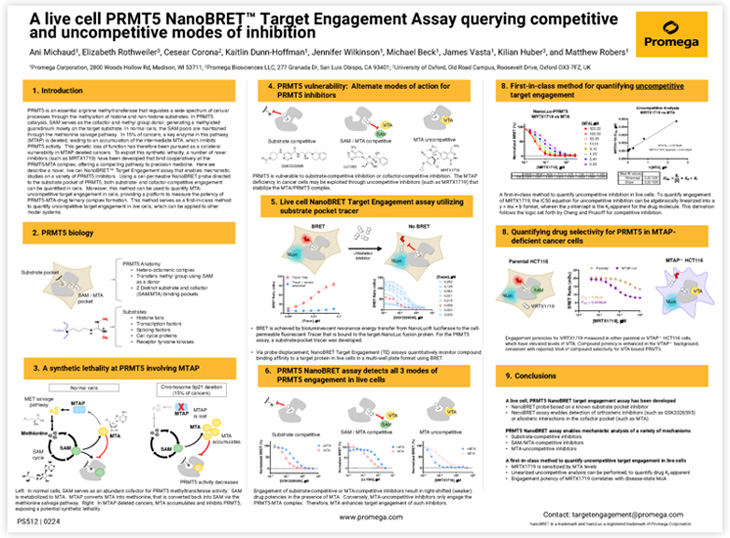
A live cell PRMT5 NanoBRET® Target Engagement Assay querying competitive and uncompetitive modes of inhibition
A live-cell PRMT5 NanoBRET® Target Engagement (TE) Assay is now developed that enables the analysis of PRMT5 inhibitors with a variety of modes of action, including inhibitors that are MTA-cooperative. Engagement potency of MTA-cooperative inhibitor MRTX1719 measured by the TE assay correlates with disease-state MoA.
Related Products
類似製品
NanoBRET® Target Engagement Kinase Assays
キナーゼ - リガンド親和性およびレジデンスタイム(滞留時間)を直接的に定量測定する生細胞でのターゲットエンゲ―ジメントアッセイ
N2520, N2521, N2540, N2501, N2500, N2530, N2600, N2601, N2620, N2621, N2630, N2631, N2640, N2641, N2650, N2651, NF1001, N2810, N2820, N2830, N2840, N2850, NF1200
NanoBRET® TE POLQ Helicase and Polymerase Domain Assays
Quantify compound affinity and fractional occupancy against Pol-theta in live cells.
CS3489A04, CS3489A23, CS3489A33, CS3489A32, CS3489A05, CS3489A24
NanoBRET® TE Assays for PARPs and PARG
Quantify compound affinity and occupancy against PARG and multiple PARPs in live cells.
CS3489A25, CS3489A26, CS3489A27, CS3489A28, CS3489A06, CS3489A07, CS3489A08, CS3489A09, CS3489A10, CS3489A11, CS3489A34, CS3489A35, CS3489A37, CS3489A38, CS3489A39, CS3489A40, CS3489A41
関連製品
Intracellular TE Nano-Glo® Substrate/Inhibitor
NanoLuc®-HaloTag®融合タンパク質をコードし、効率的なエネルギー転移を確実にするためにNanoLuc®ドナーとHaloTag®アクセプタータンパク質がつながれています。
N2162, N2160, N2161
Tracer Dilution Buffer
Buffer required to maintain solubility of concentrated solutions of NanoBRET® Intracellular TE Tracers when diluting into an aqueous solution.
N2191
FuGENE® HD Transfection Reagent
トランスフェクション困難な細胞株を含む広範な細胞腫に、より優れたパフォーマンス
E2311, E2312
GloMax® Discover System
発光・蛍光・吸光度測定に対応した高性能マイクロプレートリーダー
GM3000