Caspase-Glo® 3/7 Assay System
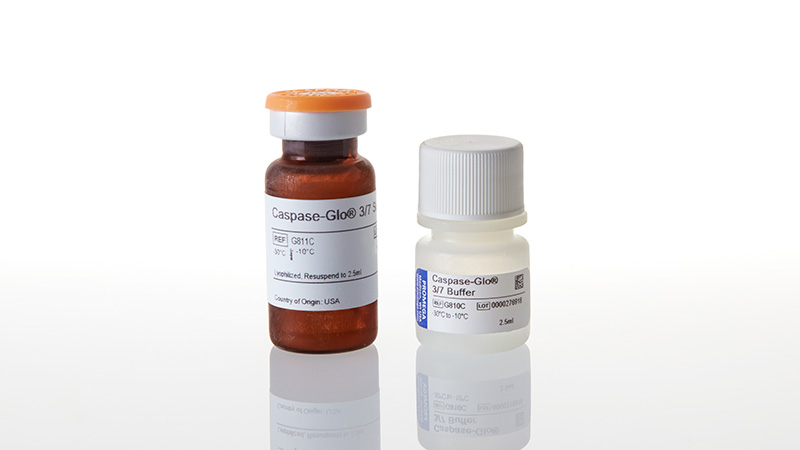
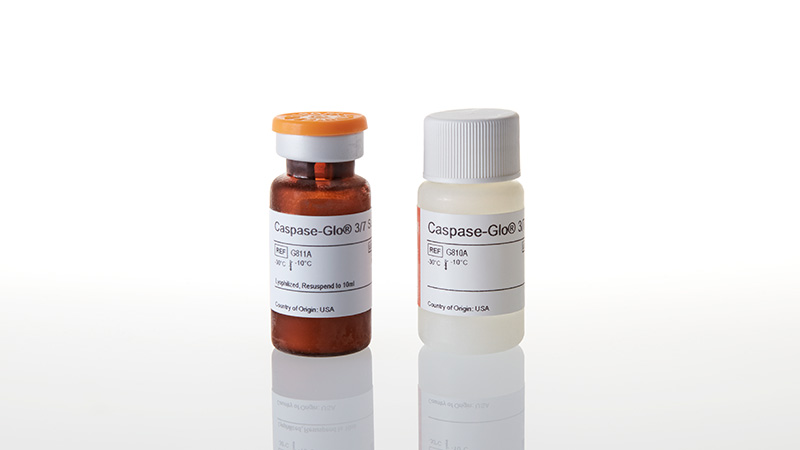
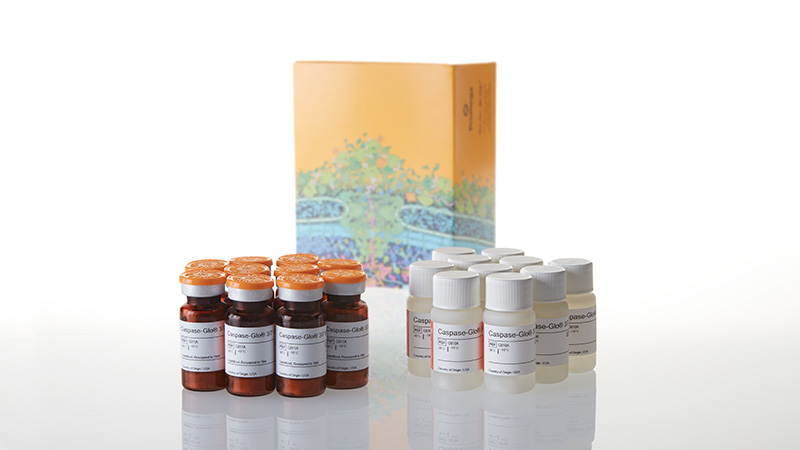
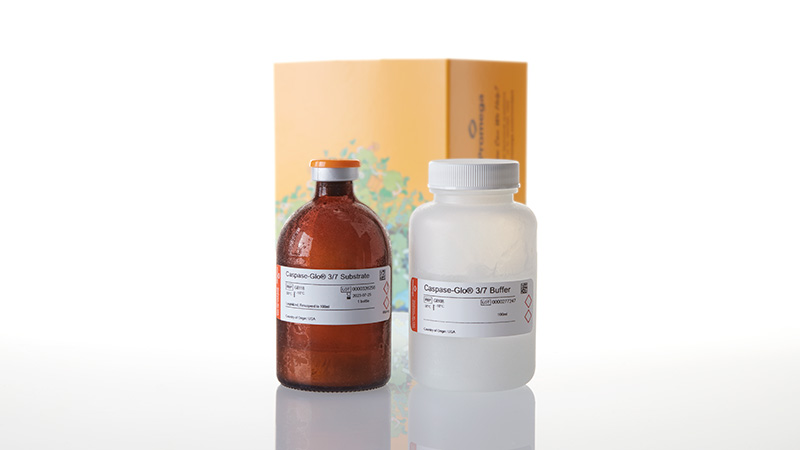
アポトーシス検出用カスパーゼ活性アッセイ
- 高感度カスパーゼアッセイ、少ない細胞数と酵素量で測定可能
- 添加 - 混和 - 測定のシンプルなプロトコルで、サンプル前処理は不要
- 96ウェル・384ウェル・1,536ウェルフォーマットへの容易なスケーラビリティ
- MyGlo™ Reagent Readerとのシームレスな統合運用

Catalog Number:
Choose a product
Size
Catalog Number: G8090
Catalog Number: G8091
Catalog Number: G8093
Catalog Number: G8092
カスパーゼ-3/7 活性を測定する発光ホモジニアスアッセイ
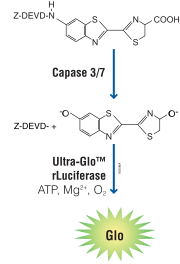
Caspase-Glo®3/7 Assayはカスパーゼ3/7活性を測定するためのホモジニアスな発光アッセイです。このシステムは発光前駆体基質であるカスパーゼ-3/7DEVD-アミノルシフェリンおよび特殊な耐熱性ルシフェラーゼを試薬として供給し、カスパーゼ-3/7活性、ルシフェラーゼ活性および細胞溶解に最適化されています。Caspase-Glo®3/7 Reagentを”添加-混和-測定”フォーマットで1回添加すると、細胞溶解および基質のカスパーゼによる切断が起こります。これによりフリーのアミノルシフェリンが遊離し、それが"グロータイプ"の発光シグナルを生じるルシフェラーゼにより消費されます。このシグナルはカスパーゼ-3/7活性に比例します。安定化ルシフェラーゼおよび特殊なバッファーシステムはアッセイ条件のレンジ幅を広げ、蛍光または発色ベースのアッセイとは異なり化合物による干渉を受ける可能性も飛躍的に低減しました。Caspase-Glo®3/7 Assayは、精製酵素または培養細胞を用いたマルチウェルプレートで使用するようにデザインされています。
【Q&A】Caspase-Glo. セルベースのカスパーゼアッセイ
【パフォーマンス】少数の細胞で迅速にアッセイできるホモジニアスタイプの Caspase-Glo™ 3/7 Assay
【アプリケーション】
ホモジニアスなセルベースアッセイを用いたマルチアッセイ
上皮性卵巣癌細胞株におけるカスパーゼ活性と 化学物質に対する反応との相関性
UV 照射により誘導された アポトーシスのCaspase-Glo™ 3/7 Assayを用いた検出
細胞生存性試験、カスパーゼアッセイおよびレポーターアッセイを組み合わせたマルチアッセイ
セルベースマルチアッセイの自動化:EnduRen™, CellTiter-Glo®
薬剤開発プロファイリング
化合物プロファイリング
細胞生存性試験
【ガイド】実験に即したセルベースアッセイの選び方
【バックグラウンド】生物発光の利点
Need to measure caspase activity in 3D cultures? See our new Caspase-Glo® 3/7 3D Assay!
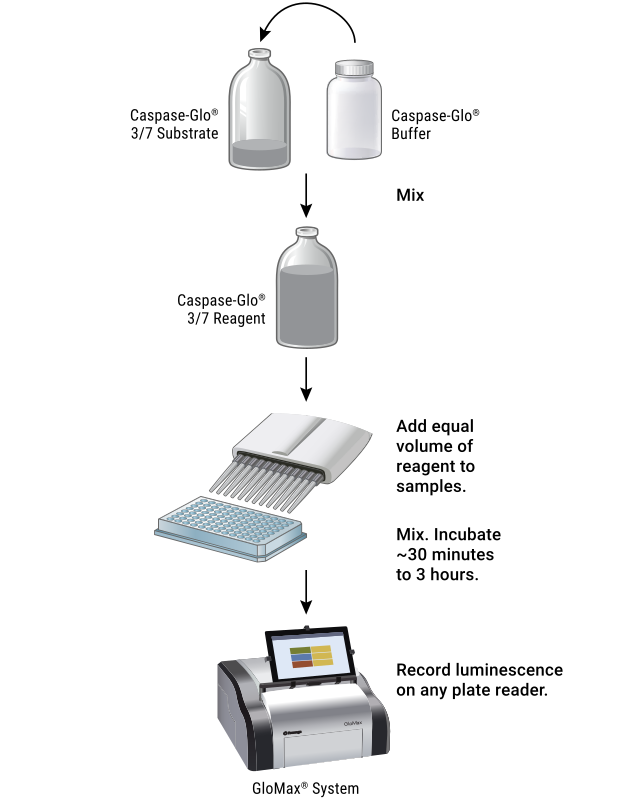
Caspase-Glo 3/7 Assay プロトコール
The assay works in three straightforward steps.
- Add an equal volume of the single Caspase-Glo® 3/7 Reagent directly to cells in a multiwell plate. The reagent simultaneously lyses the cells and provides the luminogenic caspase substrate.
- Mix briefly and incubate at room temperature for 30 minutes to 3 hours.
- Measure luminescence on a plate reader. No cell lysis buffer, washing, or substrate addition steps are required.
The proprietary reagent formulation combines a thermostable luciferase, the DEVD-aminoluciferin substrate, and an optimized buffer system in a single ready-to-use solution. This design produces a stable luminescent signal with a half-life greater than 5 hours, giving you a wide measurement window and reducing the need to read plates immediately.
ワイドレンジのアポトーシスアッセイ
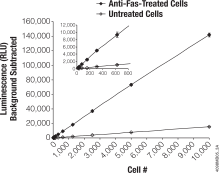
Jurkat cells were treated with anti-Fas mAb for 4.5 hours to induce apoptosis or were left untreated. Caspase-Glo® 3/7 Reagent was added directly to the cells in 96-well plates and incubated for 1 hour before recording luminescence. Each point represents the average of 4 wells. The "no cell" blank control value has been subtracted from each.
Measure Dose Response to Apoptosis Inducers
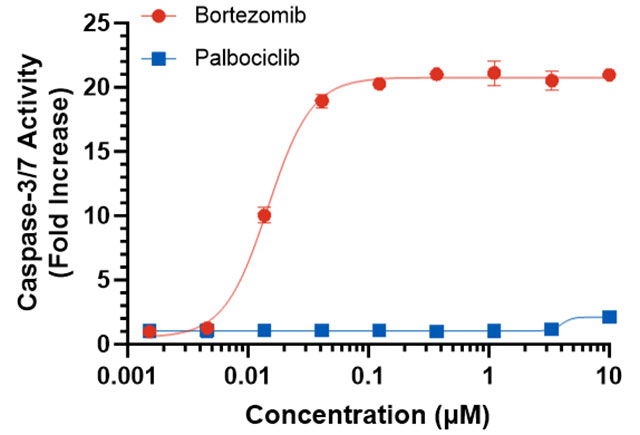
Jurkat cells were seeded at 10,000 cells/well and treated for 20 hours with two compounds. Caspase-Glo® 3/7 Reagent was added to the cells and luminescence measured on the MyGlo® Reagent Reader. The dose-response graph shows an apoptotic response to bortezomib with no apoptotic response to palbociclib.
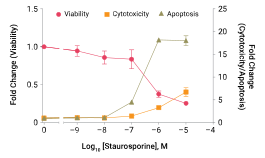
Multiplex Caspase 3/7 with Cytotoxicity and Cell Viability Assays
The Caspase-Glo® 3/7 Assay chemistry is used in the ApoTox-Glo™ Triplex Assay, which measures cell viability, cytotoxicity, and apoptosis from the same well in a single experiment. This multiplexed approach lets you assess multiple endpoints without splitting your sample, preserving precious cells and reducing plate-to-plate variability.
In the triplex workflow, you first add a fluorescent viability/cytotoxicity reagent, measure, then add the Caspase-Glo® 3/7 Reagent and measure luminescence. The sequential format avoids signal interference between fluorescent and luminescent readouts. The result is a comprehensive cell health profile that reveals whether your treatment is affecting viability, membrane integrity, or caspase-dependent apoptosis.
備考
サイズ10mlは96-ウェルプレートで100ウェル分、384-ウェルプレートで400ウェル分に相当
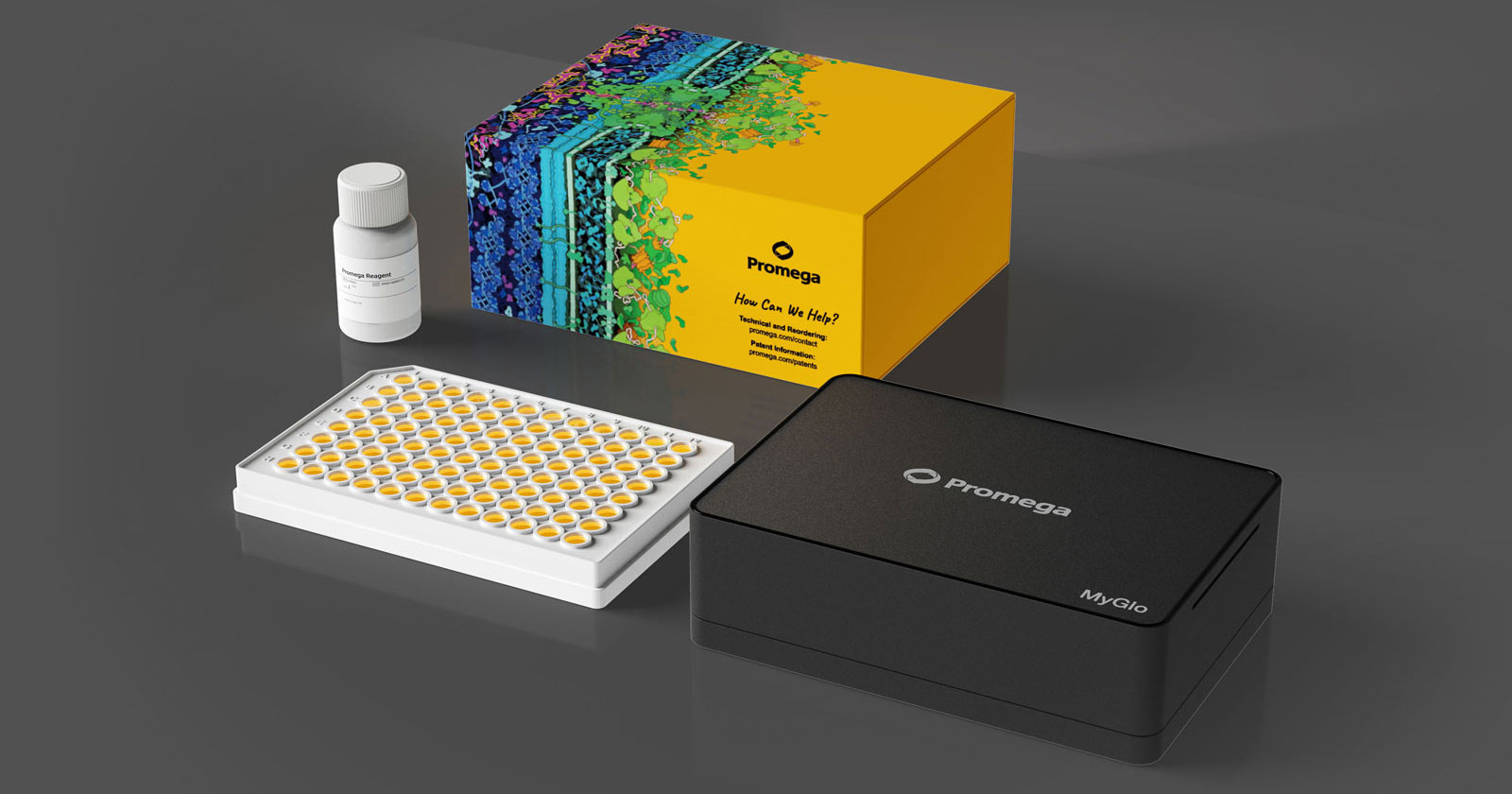
Pair with the MyGlo® Reagent Reader
Reading your assay results doesn't require a shared plate reader. The MyGlo® Reagent Reader is a compact 96-well luminescence plate reader, enabling you to run luminescent assays at your bench without competing for instrument time. Integrated software generates dose response curves, single concentration and linearity analysis in minutes.
Protocols
Complete Protocol
Specifications
Catalog Number:
選択製品の構成品内容
| Item | Part # | Size |
|---|---|---|
|
Caspase-Glo® 3/7 Buffer |
G810C | 1 × 2.5ml |
|
Caspase-Glo® 3/7 Substrate |
G811C | 1 × 1 bottle |
選択製品の構成品内容
| Item | Part # | Size |
|---|---|---|
|
Caspase-Glo® 3/7 Buffer |
G810A | 1 × 10ml |
|
Caspase-Glo® 3/7 Substrate |
G811A | 1 × 1 bottle |
選択製品の構成品内容
| Item | Part # | Size |
|---|---|---|
|
Caspase-Glo® 3/7 Buffer |
G810A | 10 × 10ml |
|
Caspase-Glo® 3/7 Substrate |
G811A | 10 × 1 bottle |
選択製品の構成品内容
| Item | Part # | Size |
|---|---|---|
|
Caspase-Glo® 3/7 Buffer |
G810B | 1 × 100ml |
|
Caspase-Glo® 3/7 Substrate |
G811B | 1 × 1 bottle |
Resources
技術記事
- Using a Real Time Kinetic Cytotoxicity Assay to Determine when to Detect Apoptosis by Caspase-3/7 Activation
- Profiling Compound Effects on Cell Health Using a Multiplexed Assay
- Elevated expression of miR-494-3p is associated with resistance to osimertinib in EGFR T790M-positive non-small cell lung cancer
- Enhanced extrinsic apoptosis of therapy-induced senescent cancer cells using a death receptor 5 (DR5) selective agonist
- Targeted zinc-finger repressors to the oncogenic HBZ gene inhibit adult T-cell leukemia (ATL) proliferation
- Metformin attenuates rotenone-induced oxidative stress and mitochondrial damage via the AKT/Nrf2 pathway
- Endogenous retroviruses mediate transcriptional rewiring in response to oncogenic signaling in colorectal cancer
Related Products
類似製品
Caspase-Glo® 3/7 3D Assay
3D培養中のカスパーゼ-3/7活性を測定するシンプルな発光アッセイ
G8981, G8982, G8983
RealTime-Glo™ Apoptosis and Necrosis Assay
アポトーシスの進行を連続的にモニタリングするワンステップのプレートベースアッセイ
JA1011, JA1012, JA1000, JA1001
Apo-ONE® Homogeneous Caspase-3/7 Assay
活性型 カスパーゼ-3 および -7 の迅速で高感度な蛍光アッセイ
G7792, G7790, G7791
Caspase-Glo® 8 Assay Systems
ホモジニアスなカスパーゼ-8 発光アッセイ
G8200, G8201, G8202
関連製品
GloMax® Discover System
発光・蛍光・吸光度測定に対応した高性能マイクロプレートリーダー
GM3000
CellTox™ Green Cytotoxicity Assay
細胞死に伴う細胞膜破壊により細胞毒性を蛍光で測定
G8741, G8742, G8743, G8731
MyGlo® Reagent Reader
発光アッセイのセットアップと解析を効率化するオールインワンソリューション
MG1010, SA4050
LDH-Glo™ Cytotoxicity Assay
3Dマイクロティッシュなど細胞数の少ないサンプルに対応した、高感度な発光ベースLDH細胞傷害性アッセイ
J2380, J2381
Product Citations
Recent publications that mention the use of this product.
Frequently Asked Questions
How many cells do I need per well for the Caspase-Glo® 3/7 Assay?
Cell number depends on your cell type and the expected level of caspase activation. For most adherent and suspension cell lines, 1,000 to 20,000 cells per well in a 96-well plate provides a reliable signal. Because luminescent detection has very low background, you can work with fewer cells than fluorescent assays typically require. Run a cell titration during assay optimization to determine the optimal seeding density for your system.
How long is the luminescent signal stable?
The glow-type luminescent signal has a half-life greater than 5 hours under standard conditions. This extended stability gives you a wide measurement window and means you do not need to read plates immediately after the incubation period. For best results, read plates within 3 hours of adding reagent.
Can I use the Caspase-Glo® 3/7 Assay with 3D cell culture models?
For standard 2D cultures, the Caspase-Glo® 3/7 Assay works well as described. For 3D models such as spheroids, organoids, or microtissues, we recommend the Caspase-Glo® 3/7 3D Assay, which includes enhanced lytic capacity to penetrate dense 3D structures and ensure complete cell lysis.
Does serum in the culture medium affect results?
Fetal bovine serum and other sera can contain low levels of endogenous caspase-3/7 activity, which may contribute to background signal. Always include a “no-cell” control containing medium plus serum (without cells) and subtract this background from your experimental readings. This correction ensures your results reflect caspase activity from your treated cells only.
What plate reader should I use?
Any luminometer or multimode plate reader capable of reading luminescence is compatible. We recommend the GloMax® Discover or GloMax® Navigator plate readers, which are preloaded with optimized protocols for Promega luminescent assays and do not require gain adjustments. For a streamlined benchtop option, the MyGlo® Reagent Reader pairs with the ProNect™ Data Platform for simplified data capture and visualization.
Can I multiplex the Caspase-Glo® 3/7 Assay with other assays in the same well?
Yes. The Caspase-Glo® 3/7 Assay chemistry is the apoptosis component of the ApoTox-Glo™ Triplex Assay, which sequentially measures viability (GF-AFC substrate), cytotoxicity (bis-AAF-R110 substrate), and apoptosis (Caspase-Glo® 3/7) from one well. You can also pair the Caspase-Glo® 3/7 Assay with the RealTime-Glo™ MT Cell Viability Assay or CellTox™ Green Cytotoxicity Assay for custom multiplex experiments.